Does Your Response Really Matter?

Response slide

“Does Your Response Really Matter?” I think most of us would agree that the answer to that question is YES! I am personally learning it’s not so much what others do, or how I feel about what they’ve done; what matters is, how I respond. One of the many things I have learned from this teaching is: “your response to me doesn’t affect me, unless I allow it to.” However it does affect you in regards to your future and your peace. Sometimes your response is more important than the offense that has happened to you. That’s because you can’t change the offense, but you can change your future by how you respond. Your level of maturity is seen in your response, not your retaliation.

Here are some notes from the teaching regarding Joseph being thrown in the pit and how he responded:

Joseph:

  • He responded in a Godly manner.
  • He saw the bigger picture.
  • He understood God was involved.
  • He blessed those who cursed him.

Joseph’s response to his “not so fortunate” circumstances promoted him while releasing God’s favor for him and also for those who created his unfortunate circumstances. A Godly response will release the favor of God in your life and in the lives of others.

Joseph’s response to the Pit, Potiphar’s wife and the Prison promoted him to the Palace. The Palace was a place that allowed him the opportunity to bless others. His response to those unfortunate situations promoted him to an opportunity of great fortune that empowered him to bless others.

It’s easier to respond in the proper way:

  • When you realize God has a plan.
  • When you know He is faithful.
  • When you believe His word is true.

Your response matters and it will release your future!

Seeing the Greater Purpose


Seeing the Greater Purpose Slide
Seeing the Greater Purpose – 2 Corinthians 4:7-17
I recently watched the “Youngstown Boys.” It’s a ESPN short film about former Ohio State coach Jim Tressel and his players from Youngstown, Ohio. Here is Tressel’s thoughts regarding Maurice Clarett: “People wanted me to give up on him, but you don’t easily give up on someone you love. Your goals and perspective are constantly being revised because of circumstances, but your purpose, the reason you are here on the earth, supersedes circumstances; what you are going through, and why? Maybe that’s why his goals (speaking of Clarett) didn’t come to pass. It’s because they didn’t align with his purpose. However, the entire time, it was his goals and the adversity that he experienced that led him to a greater purpose.”

We have probably all at one time or another found ourselves in a place of fear, frustration, or failure, focusing on our circumstances, while forgetting there may be a greater purpose to what we are going through. Let me say it this way: “We focus so much on what we are going though, that we sometimes fail to see there might be a purpose behind, what we are going through.” The purpose may not be the circumstance itself, the purpose is usually far greater and farther down the road than we can even think or see. You need to ask God for the wisdom to see the greater purpose while finding the courage to confront the circumstance allowing you the strength and the grace to sustain through the season of the whatever it is that you may be facing.

Here are some quotes regarding mindsets, perspective and belief:
– Maurice Clarett – “when you have the right mindset everything else just lines up.”

– Joel Osteen – “opposition is not meant to stop you but establish you.”

– Darius Daniels – “all God’s promises are occupied with opposition.”

– Mark Batterson – “adversity is the seed bed of opportunity.”

– Robert Alan Collins – “adversity & opposition are not meant to destroy you – they are meant to develop you while revealing God’s purpose and your destiny.”

– Rick Warren – “Every storm is a school. Every trial is a teacher. Every experience is an education. Every difficulty is for your development.”

The Apostle Paul in Acts 16:25-40 experienced hardship but there was a greater purpose to what he was experiencing. He was falsely accused, beaten and thrown in prison. This passage tells us that at midnight in shackles and chains held confined in the darkest part of the prison cell Paul began to sing praises to God at midnight. Why? Because he enjoyed being falsely accused? No! Why? Because he was glad to be in jail? No! Why? Because he loved the sting of the stripes on his back? NO! It was because Paul realized there was a greater purpose and although he may not have understand at the time, he praised God and trusted Him in spite of his circumstances. The greater purpose was the Philippian Jailer and his family being saved.

Here are 7 things we can learn form this:

1. Be careful what you say and how you say it.
2. Don’t complain about what God may be using.
3. Your response could be a key to someone else’s future and freedom.
4. Sing God’s praises and don’t magnify the circumstance.
5. God can use the natural to produce the supernatural.
6. Don’t allow your response to be based on assumptions.
7. The trial ends when God’s purpose is accomplished.

Here are some examples of – “maybe there is a greater purpose that I don’t see, but I can trust God praise Him in spite of my circumstances.”

*Paul & Silas – “maybe the stocks and chains weren’t meant to keep Paul bound – maybe they were to loose the spirit of God’s love.”

*Paul & Silas – “maybe the cell doors opening weren’t meant to set Paul free – maybe they were opened to open the heart of the Philipian jailer.”

*Gideon and His Mighty Army – “maybe the depletion of Gideon’s army wasn’t to set him up for defeat – maybe it was to prove you can trust God because He is faithful!

*The Children of Israel and the Red Sea – “maybe the Red Sea wasn’t meant to the delay the promised land – maybe it was meant to destroy Pharaoh’s Army.

*Daniel in the Lions Den – “maybe the lions den wasn’t meant to destroy Daniel – maybe it was to prove to Daniel and everyone else that you can rest in the midst of intimidation, fear, and being devoured.”

*Shadrach, Meshach, and Abednego – “maybe the fire wasn’t meant to destroy the 3 Hebrew Children – maybe it was meant to destroy what bound them, while proving to everyone that you can walk through a fiery trail without losing your faith or being destroyed!”

*Jesus – “without a betrayal there wouldn’t have been a trial – without a trial there wouldn’t have been a cross – without a cross there wouldn’t have been a death – without a death there wouldn’t have been a tomb – without a tomb there wouldn’t have been a resurrection – without a resurrection there wouldn’t have been redemption for all mankind!”

In all of these scenarios from the Bible there was a greater purpose. Don’t get discouraged, there may a greater purpose to the circumstances you are facing. You may never know or totally understand, but you can trust God and praise Him in the midst of what you are going through right now, because there  could be a greater purpose to what you are going through. What you thought would destroy you, God used to develop you. Don’t despise what you are going through, there may be a greater purpose!

The Greatest of These…

Click Text for Short Video Clip: the greatest is love

When you say nothing at all…

Do you ever feel like your words are not being heard? Have you ever felt like what you say isn’t making a difference? Whether you speak or whether you are silent; both must be done in love. We should all have a desire to speak the truth, but even the truth has to be spoken in love! However when we are silent most of the time it is done for manipulation through pouting. In Luke 19 Zacchaeus climbs a tree to see Jesus. When Jesus looks up and sees him He tells him to come down because He needs to go to his house today.

Zacchaeus was a crooked tax collector who cheated people out of money. Jesus knew it and Zacchaeus knew it, but nothing was ever spoken. And without one word “spoken” he repents and the fruit is restitution. He not only says he was wrong he tells Jesus he will give back with interests what he has stolen from the people.

Jesus never said a word about what Zacchaeus should or shouldn’t do or for that matter what he had  or hadn’t done. Zacchaeus repented without Jesus saying a word!  Moved by the audacity of Jesus’ undeserved love and acceptance, Zacchaeus publicly repented of his acts of corruption and vowed to make restitution for them, and held a feast at his house. I want you to know love is a two way street. Jesus received Zacchaeus just the way he was but Zacchaeus received Jesus into his home. Love has to be given, but it also must be received.

There is a lot of talk about law and love, grace and truth, love and grace. I want you to note Jesus never said anything about Zacchaeus’ wrongdoings but Jesus also never tried too justify what he had done as being ok. Jesus never said, “Thats o.k. Zacchaeus you don’t have to give back what you have taken.” No. He allowed him freedom but He also allowed him the opportunity to repent and be changed. It’s both! Love and grace, law and love, grace and truth.

Sometimes love speaks, sometimes love is silent, sometimes love presents the truth, but no matter how our actions are displayed it should always be done in love! If your words or silence are not done in love they will sound like a “*clanging cymbal” to the person who is receiving them. (*I Corinthians 13)

The way to know your speaking more “truth” than “love”:

1. When you want to prove your point more than resolve the issue.

2. When you want to be heard more than you want to hear.

3. When you want to be right more than you want a resolve.

4. When your ego is more important than the person’s need.

5. When you listen but don’t hear.

6. When your wrong but don’t recognize it.

7. When you are in the wrong but don’t admit it.

8. When you say the wrong thing at the wrong time in the wrong way.

9. When you talk so much people don’t value what you do say when you say something worth hearing.

10. When you consider how you feel more than how others feel.

Many of us speak the truth, but not in love. We speak more truth than love. Speak the truth, but do so in love. Say what you mean and mean what you say, but don’t be mean!

It Takes Both

It Takes Faith & Courage
I Samuel 17 – (David & Goliath)

You can have faith but without courage you won’t act upon it.

Faith (pistos)- belief, confidence and trust.
Faith has to do with belief. *(Believing God to do something)
Courage has to do with confidence and trust. (Trusting God can see you through whatever it is you are facing)

Be courageous, be of good cheer, don’t be afraid. (Acts 23:11/Joshua 1:9)
Acts 23:11: tharseō; from 2294; to have courage: — be of good cheer; marvel, wonder, courage, confidence, boldness, daring, bold courage.

Joshua 1:9: h0553. אָמַץ ’âmaṣ; a primitive root; to be alert, physically (on foot) or mentally (in courage): — confirm, be courageous (of good courage, steadfastly minded, strong), establish, fortify, harden, increase, prevail, strengthen (self), make strong (obstinate, speed).

– At some point your faith has to produce courage.
– It takes courage to act upon what you believe.
– You need wisdom when being courageous; so you are not foolish.

At some point your faith has to produce a confidence that is developed by remembering God’s faithfulness in past situations while believing He will be faithful in the moment you are being faced with right now!

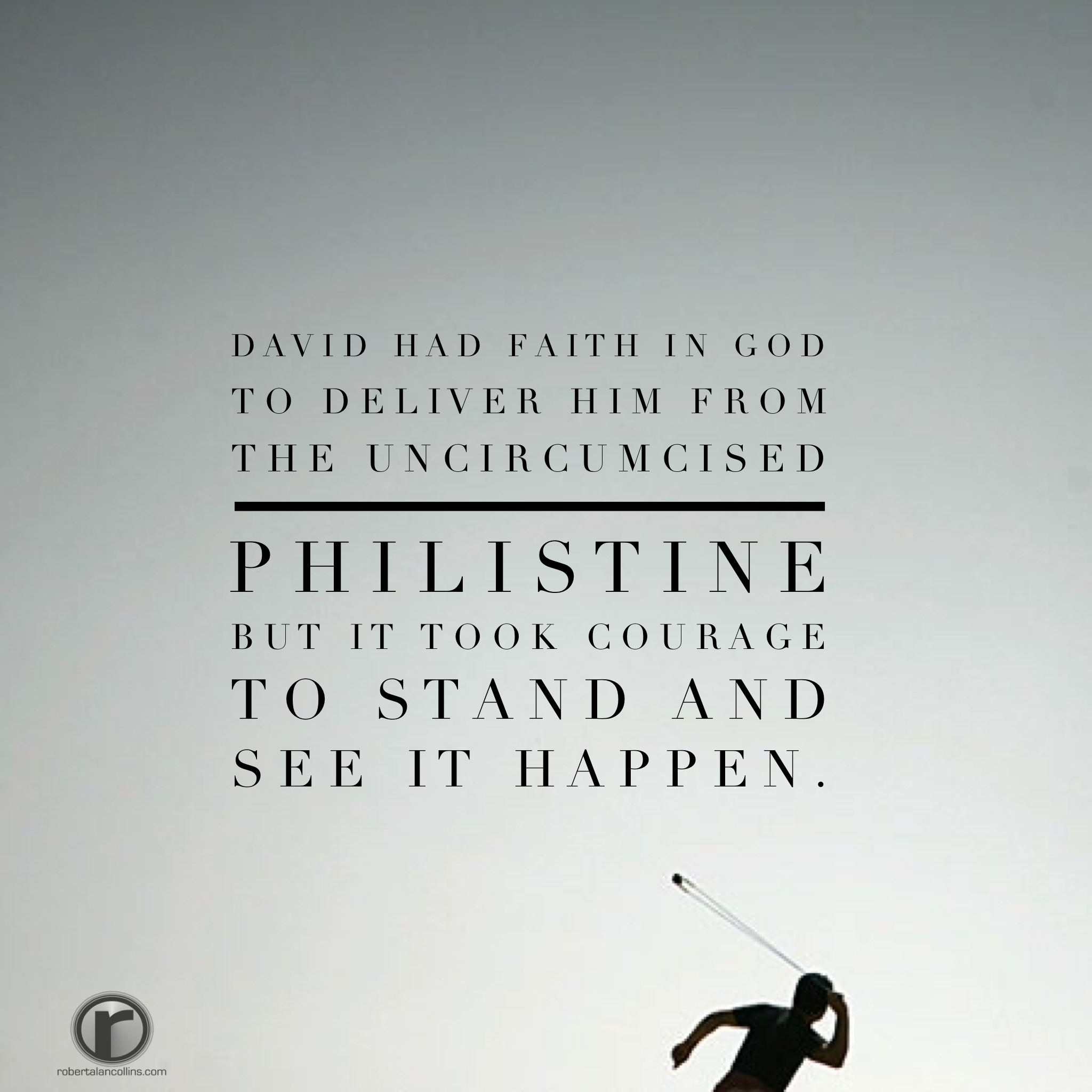
*David – said if God delivered me from a bear and lion He is well able to deliver me from this uncircumcised Philistine. What God had done in the past gave David courage for his current situation with facing Goliath.

It Takes Faith & Courage…

1. To act when everyone else is just talking. Faith & Courage says the right thing: David said, “my God is able.” While everyone else was saying this giant is big.

2. To say what know one else will say. Faith & Courage will say what know one else will say: David called him an, “uncircumcised Philistine.” While everyone else called him the giant Goliath.

3. To act upon what you believe and feel is right. Faith & Courage will stand for what is right: David said, “is there not a cause?” While everyone else believed they didn’t act upon what they believed.

4. To face what seems impossible. Faith & Courage will face what seems impossible while trusting God: David was a boy with 5 stones, and a slingshot facing a giant. But he said, “I come against you in the name of the Lord!” With men some things are impossible but with God all things are possible.

5. To know know who you are and what you have; yet trust who you are in Him to be more than enough. *Gideon (the weakest of His clan/mighty man of valor) *David (a young shepherd boy delivered the giant). The God in you is more than enough to face whatever it is that you may face but you have to have the faith to believe and the courage to act upon what you believe.

6. To “NOT” listen to what others are saying. David didn’t listen to the sarcastic remarks about being young or getting killed and he didn’t wear Saul’s armor either. He listened to his heart and he moved in faith and acted in courage.

7. To see extraordinary things accomplished for the glory of God and the benefit of others. The slaying of the giant was a benefit for the people of God and it brought God glory. V.25

– It takes faith to believe God; but it takes courage to stand and see Him move on your behalf.

– It takes faith to believe; but it takes courage to respond to what matters; but it also takes wisdom to “NOT” respond to what doesn’t matter.

– Faith believes that God says what He means; courage believes that God means what He says.

Grateful Perspective

attitude-of-gratitude

Perspective is an impression of how we mentally view someone or something. We all see things through the eyes that we see them through; but our mind and heart are filters that cause us to perceive what we see. When you see through eyes of hurt, frustration, fear, anger or doubt it determines not only what you see, but how you see. When I was a boy growing up there was a country and western song that said, “these rose colored glasses that I am looking through show only the beauty because they hide all the truth.” Sometimes what we see is determined by the lens we are looking through. When we see through “Rose Colored Glasses” every thing tends to look “Rosie” (every pun intended). Being grateful is a matter of perspective. It is also a choice. If you look long enough, hard enough and deep enough, you will find something to be grateful for.

What lens you choose to look through determines what you see. When you magnify something you see it as being bigger. It doesn’t get bigger it appears bigger. A magnifying lens makes the words on the page appear bigger, but if you were to look underneath the magnifying lens at the words on the page you will find they didn’t get any bigger although they appeared bigger while looking through the magnifying lens. Do you magnify your burdens or do you magnify your blessings? What you magnify matters! What you magnify becomes bigger. The writer says, “come let us magnify the Lord together.” Can we make God bigger? No. But could we see Him as being bigger? Yes. When magnify God we see Him as being bigger than our burdens. Again what you magnify matters! How you see things and the lens you see them through matters too.

Paul wrote a lot of the new testament; some of which he wrote while in prison. In Philippians 1 he says this: “I thank my God every time I remember you. In all my prayers for all of you, I always pray with joy. I am happy because you have joined me in spreading the good news. You have done so from the first day until now. I am sure that the One who began a good work in you will carry it on until it is completed. That will be on the day Christ Jesus returns. It is right for me to feel this way about all of you. I love you with all my heart. I may be held by chains, or I may be standing up for the truth of the good news. Either way, all of you share in God’s grace together with me. God can give witness that I long for all of you. I love you with the love that Christ Jesus gives. I pray that your love will grow more and more. And let it be based on knowledge and understanding. Then you will be able to know what is best. You will be pure and without blame until the day Christ returns. You will be filled with the fruit of right living produced by Jesus Christ. All of those things bring glory and praise to God.” You talk about a “Grateful Perspective!”

Here are 5 Things We Need to Remember When it Comes to Gratitude:

  • Be grateful and realize everything you have comes from God.

  • Be grateful and don’t take anything or anyone for granted.

  • Be grateful for what you have even if it’s not all you need.

  • Be grateful for what you have even if it’s not what you want.

  • Be grateful for the broken pieces of the process that someday will produce the full picture.

Gratefulness unleashes the generosity of God. Gratitude is a choice. Perspective is what you choose to see. What you choose to see will produce gratefulness or grieving – burdens or blessings. God knows what you need. He wants to know if you are grateful for what you have. What lens are you looking through? See  through eyes of gratefulness and it  will begin to change your perspective. You can can see with your heart what you will never see with your eyes. Magnify the Lord! See life through the lens of gratefulness and watch what happens. I believe you will develop like Paul, a Grateful Perspective.”

Insignifanct Compared To My Need

The widow in II Kings went to Elijah asking for help. Her husband had died and left her with a debt she couldn’t pay. She needed money. What she had was a little bit of oil. The man to whom the money was owed was going to take her sons as slaves if the debt could not be paid in full. She was the widow of a prophet so she goes to a prophet to ask for help. But before Elijah did anything to help, he asked her a question: “what do you have in your house?” She replied, “absolutely nothing!’ …”except for a little oil.” You see what she had seemed insignificant when she compared it to what she needed. What she needed was a “whole lot” of money what she had was a “little bit” of oil. Don’t ever underestimate what you have! Especially when God gets involved.

It’s an interesting question coming from a prophet to a widow and it is an interesting answer considering she said she didn’t have anything, except for a little oil. Now when we say we don’t have anything we usually mean we don’t have anything. But for most of us it’s not that we don’t have anything; it’s that we don’t have what we desire. When what you have is not what you desire it will be overlooked and seen as nothing. What she had she didn’t value as significant because it wasn’t what she needed. What she needed was a lot of money. What she had was a little bit of oil. Mike Murdock says, “if what you have is not what you need it must be your seed.” Your seed will look like “absolutely nothing” until you begin to sow it by pouring out of what you already have. Then it will grow and exceed your need. The widow had a “seed” of oil and when she began pouring out of what she had God exceeded her need.

This story is interesting in so many ways. First of all instead of the prophet just helping – he first asked her what she had in her house. Most of us would have taken for granted she didn’t have anything. While others of us would have helped her without any questions being asked at all. Then to top it all off when he found out she had a little oil he still doesn’t help her but instead he proceeds to tell her to go to her neighbors and ask them for some empty jars. After collecting all the jars should could find the prophet then instructs her to begin pouring into those jars. So she did. She began pouring out of what she already had. She began pouring from what she called earlier: “ABSOLUTELY NOTHING.”

The oil didn’t start flowing until she started pouring. But the “little bit” of nothing she had kept flowing until it had filled all the jars she had collected. Then the oil stopped. It didn’t stop until the containers she had were filled. God didn’t exceed her capacity to receive, but He exceeded her need. I believe if she had more jars she might still be pouring today. The other thing is the oil started flowing when she started pouring out of what she had. The jars didn’t automatically fill themselves, and the jar she had didn’t fill up before she started pouring. You may be waiting on God to give you more, or to give you what you desire, but He might be waiting on you to recognize what you have as being significant so you will begin pouring it out for Him, to exceed your need while blessing those around you.

She had a “little bit” of oil but what she needed was a “whole lot” of money. What seemed insignifanct, God used in a supernatural way. The writer tells us that she had enough oil to pay off her husband’s debt with enough left over for her and her sons to live on. Here’s the passage: II Kings Chapter 4 “Elisha and the Widow’s Oil” – “A certain woman of the wives of the sons of the prophets cried out to Elisha, saying, “Your servant my husband is dead, and you know that your servant feared the Lord. And the creditor is coming to take my two sons to be his slaves.” So Elisha said to her, “ What shall I do for you? Tell me, what do you have in the house?” And she said, “Your maidservant has nothing in the house but a jar of oil.”
Then he said, “ Go, borrow vessels from everywhere, from all your neighbors — empty vessels; do not gather just a few. And when you have come in, you shall shut the door behind you and your sons; then pour it into all those vessels, and set aside the full ones.” So she went from him and shut the door behind her and her sons, who brought the vessels to her; and she poured it out. Now it came to pass, when the vessels were full, that she said to her son, “ Bring me another vessel.”
And he said to her, “ There is not another vessel.” So the oil ceased. Then she came and told the man of God. And he said, “ Go, sell the oil and pay your debt; and you and your sons live on the rest.”

Here are 5 Things We Can Learn from this Passage:

1. God supernaturally accomplished what the widow could not do herself.

2. God exceeded her need.

3. The miracle started with what didn’t seem signifiant.

4. She poured out of what she had and God exceeded what she needed.

5. What she had was more than enough when God got involved.

We must learn to be thankful for what we have… Develop an attitude of gratitude… Begin pouring out of what you have. What you have is your seed. What you desire God to do is your need. Be thankful for what you have and watch God exceed your need!

Hope Deferred

Hope Deferred

Proverbs 13:12

We have all hoped and been disappointed, even if it were for just a moment in time. Our disappointment comes from unmet expectation. It’s those times when we believed or hoped for something that didn’t happen or at least didn’t happen in the time frame we expected it to happen. The Bible gives us examples of stories like Lazarus whom Jesus raised form the dead yet his sisters were disappointed that Jesus didn’t come sooner; their hope was deferred, because their expectation was delayed. Jairus was the ruler of the synagogue that approached Jesus about going to his house to heal his daughter and on the way his hoped was deferred while a woman whose hope had been deferred many times received hope and was healed. However Jesus did go to the house of the ruler, and his daughter was healed. It just didn’t happen in the time frame that was expected, and for a moment Jairus was disappointed. Proverbs 13:12 says, “Hope deferred makes the heart sick, But when the desire comes, it is a tree of life.” The Message translation says it this way: “Unrelenting disappointment leaves you heartsick, but a sudden good break can turn life around.” I am thankful that my times of disappointments that may only last for a season can be turned around in an instant! We serve a God of the “turn around.” What took a lifetime to create can be changed in an instant. Someone reading this today needs to know your situation is about to turn around! Your heart may have been made sick with disappointment but its about to leap with joy in fulfilled hope. The Bible tells us that weeping may endure for the night but joy comes in the morning. When the sun sets on one season it will rise on another season. Your situation is about to turn around!  

WHAT IS HOPE?

*Hope: the feeling that what is wanted can be had or that events will turn out for the best.
*The Hebrew word simply means hope or expectation. i.e. What you hope or expect to happen.


WHAT DOES DEFERRED MEAN?

*Deferred: postponed or delayed, suspended until a certain time or event.
The Hebrew word suggests one who sows and has to wait. It means to be delayed and to continue on without results.

WHAT IS HOPE DEFERRED?

*Hope Deferred is repeated postponement of your expectation.


1. What are our Reactions when our hope is deferred?

-We get Angry. (God – self – everyone) -We become Passive-Aggressive. -We Blame everything and everyone. *(Baalam even blamed the donkey) -We want to Quit.

2. What are the Reasons we are disappointed when hope is deferred?

-We serve God Conditionally. (if you do this?) -We put are Agenda ahead of His timing. -We Idolize the wrong things. -We put our faith in what God does but not who He is.

3. What we need to do when our hope is deferred… Repent!

*repentance is simply a change of mind, heart and direction – new focus *(waiting) -Don’t give up hope on what God hasn’t given up on. -Don’t hold onto what God can give you grace to let go of. -Don’t miss what God has done by always looking at what hasn’t happened. -Don’t believe that just because it hasn’t happened doesn’t mean it never will.

7 Things To Do to Change Your Focus When Hope is Deferred:

-Be honest. -Prioritize. -Realize God is your savior and you are His servant; not vice-versa. -Return to your first love (intimacy and passion). -Seek God’s agenda and will not your own. -Focus more on being and less on doing; don’t miss the moment or purpose. -Put God and people ahead of your own dream, vision and goals and trust Him.   Joseph had a dream and that dream wasn’t deterred by the Pit, Potiphar’s house, or the Prison. It wasn’t even deterred by the Palace. He was deserted in the pit; the pit represents those things that others do that we have no control over. Have you ever been disappointed or lost hope in others?  He was betrayed and lied about at Potiphar’s house. Have you ever lost hope or been disappointed because someone believed something about you that wasn’t true? Have you ever had someone take their word over yours? Don’t lose hope God will have the final say! He was put in the prison undeservedly. Have you ever been been disappointed because you received what you felt you didn’t truly deserve? And to make it it worse Joseph met a baker and butler that said they would remember him but they didn’t. Have you ever felt overlooked or forgotten? It’s disappointing to say the least. Joseph made it to the palace and was able to see his dream fulfilled. It probably didn’t happen in the time or the way that he expected, but it did happen. He was able to examine all the circumatnces and look at his brothers and say, “What you meant for harm God has used for good.” In every delay. Through every struggle. With all of the disappointments. God used it “all” for good! Faith is the substance of things HOPED for the evidence of things NOT seen. Don’t lose hope! Keep the faith! Although you may not see it you can still hope. That called faith. There’s a story in the Bible of persistence and faith. It’s about a judge and a persistent lady. Jesus tells the parable to His followers: “The judge had no regard for God or mankind. But this woman kept knocking and asking the judge for justice. Finally the judge says to her because you won’t give up I am going to give you what you are asking for.” Then when Jesus ends the parable He says these words: “when the Son of man appears will He find faith on the earth?” If you have read the story you might have asked the same question I did: “what’s the connection?” I think what Jesus is saying is this: “When I come back will I find faith that won’t give up?” “Will I find people who in spite of their situations and circumstances didn’t quit?” “Will I find people who although they were disappointed, they still hoped?”  Here it is again Proverbs 13:12 in the Message translation: “Unrelenting disappointment leaves you heartsick, but a sudden good break can turn life around.” Galatians 6:9 tells us if we don’t grow weary in well doing we will reap what have sown for; what we have believed for. Don’t quit! Like the rock-band Journey said, “Don’t Stop Believing!” Life and people can disappoint you. Believing and expecting without seeing any tangible results can make your heart sick. But proverbs 13:12 also says a “good break” can turn your life around! As I said before we serve a God of  the “turn around.” You may be down but you are not out. God is able! Your situation is about to turn around, the hope that has been deferred is about to be fulfilled!