If you have ever been discouraged to the point of wanting to give up…
If you have ever been intimidated by what others have said…
If you have ever been disappointed by the way things turned out…
If you have ever wanted everyone to just leave you alone…
If you have ever wondered, “What’s the use?”
Or if you have ever felt like you were the only one going through what you were going through…
This message is for you.
Elijah was a man of God—a prophet who knew the voice of God, obeyed God, and had experienced God’s plans, purpose, power, and provision firsthand.
He had been provided for at the brook and fed by ravens.
He had watched God provide through a widow and miraculously multiply her flour and oil.
He had prayed over her dead son and watched God restore his life.
He had stood boldly before Ahab, confronted the prophets of Baal, watched fire fall from heaven, and prayed until the rain returned after three and a half years of drought.
Elijah knew what it was like to see God do the impossible.
But now he was running from Jezebel.
The same man who stood fearlessly before 450 prophets of Baal was now afraid of the threat of one woman.
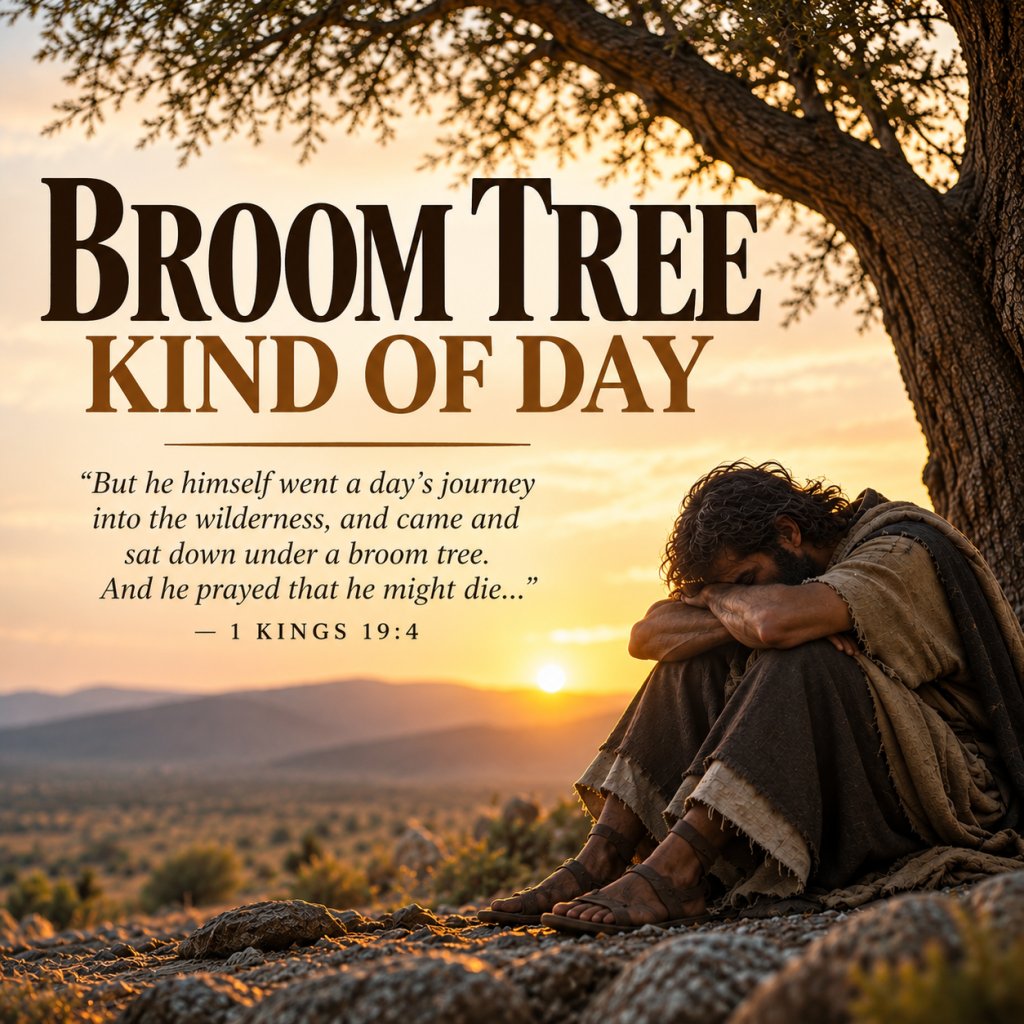
The same man who had just watched fire fall from heaven was now sitting underneath a broom tree asking God to let him die.
“But he himself went a day’s journey into the wilderness, and came and sat down under a broom tree. And he prayed that he might die…” —1 Kings 19:4
Elijah was having a broom tree kind of day.
Have you ever had one?
A day when yesterday’s victories don’t seem strong enough to overcome today’s discouragement.
A day when you know God has been faithful, but you’re just tired.
A day when you’ve poured into everyone else and feel like you have nothing left to pour.
A day when one negative voice seems louder than a hundred reminders of God’s faithfulness.
A day when you don’t necessarily want to quit forever—you just don’t want to keep doing this anymore.
That’s a broom tree kind of day.
But here is what I love about the story:
God did not abandon Elijah underneath the broom tree.
God didn’t lecture him.
God didn’t condemn him.
God met him where he was.
Elijah slept, and an angel touched him and said, “Arise and eat.”
God gave him rest. God gave him provision. God gave him strength. And eventually, God gave him direction.
Sometimes the most spiritual thing you can do when you’re exhausted is rest long enough to hear God again.
And don’t miss this:
It’s always the Lord’s provision.
The angel may have delivered it, but God was the source.
God knew what Elijah needed before Elijah knew what was coming next.
The broom tree wasn’t Elijah’s destination.
It was a stopping place.
His discouragement didn’t cancel his calling.
His exhaustion didn’t erase his purpose.
His fear didn’t negate his faith.
And one bad day didn’t determine the rest of his life.
Eventually Elijah came to Horeb, where God spoke to him—not in the wind, the earthquake, or the fire, but in a still, small voice.
There is something powerful about a whisper.
A whisper is intimate—you have to be close to hear it.
Maybe God wasn’t trying to become louder than everything happening around Elijah.
Maybe He was drawing Elijah closer.
Then God gave Elijah direction and reminded him of something he desperately needed to know: He wasn’t alone.
Elijah said, “I alone am left.”
But God told him there were still seven thousand who had not bowed to Baal.
What Elijah felt was real—but what Elijah felt was not necessarily true.
Never allow how you feel in a moment to define what is true about your life.
Sometimes you simply need to be reminded:
1. You’re doing better than you think you are. Your present struggle does not erase your past victories.
2. You have more going for you than you realize. God may be doing things around you, for you, and through you that you cannot see from where you are sitting.
3. God’s promises will come to pass. What you fear does not have the final word. God does.
And that may be one of the greatest lessons from Elijah’s broom tree:
What Elijah feared never happened.
Jezebel threatened his life, but her threat never became Elijah’s destiny.
Jezebel died.
Elijah lived.
What Elijah feared never came to pass—but what God said did.
And there was something else Elijah couldn’t see from underneath that broom tree: Elisha.
If Elijah had given up underneath the broom tree, there would have been no Elisha to receive the mantle and no double portion.
Elijah could only see the broom tree.
God could see the double portion.
Elijah still had an assignment to complete. There was still someone to anoint. Someone to mentor.
Someone who would pick up the mantle and carry the work forward.
Elijah couldn’t quit because his assignment wasn’t finished. And sometimes you don’t realize what is connected to your decision to keep going.
Someone may be waiting on the other side of your obedience.
Someone may need what God has placed inside of you.
Someone may eventually carry what God first entrusted to you.
So don’t make a permanent decision underneath a temporary broom tree.
When you’re under the broom tree, it’s easy to ask, “Why?” Why did this happen? Why did things turn out this way? Why am I going through this?
But often, there is more to the story than what we can see.
We see the moment; God sees the whole story. We see what happened; God sees what it’s producing. We see the disappointment; God sees the purpose. We see what was lost; God sees what’s ahead. We see the threat; God sees the triumph. We see the broom tree; God sees the mantle. We see where we are; God sees where we’re going.
And I love how Elijah’s story ultimately turned out:
Elijah was taken up, and Jezebel was taken out. The threat didn’t win. Fear didn’t win. Discouragement didn’t win. The broom tree didn’t win…God was faithful!
So remember:
You may feel alone—but you are not alone.
You may feel forgotten—but God has not forgotten you.
You may feel finished—but God may simply be preparing you for what’s next.
You may feel like giving up—but your broom tree may actually become the place where God restores your strength, renews your perspective, and reminds you that your story isn’t over.
So, if today happens to be a broom tree kind of day, rest if you need to. Eat something. Get quiet. Allow God to minister to you. But don’t build a house under the broom tree. You can stop there. You can rest there. You can recover there. But you can’t stay there!
Because there is still more ahead of you. There is still purpose in you. There are still people God will use you to impact. Your assignment may not be finished. Keep going.
And the God who sustained you at the brook, provided for you through the widow, answered you on the mountain, and sent the rain…
is still God underneath the broom tree.
The same God who met Elijah there will meet you there. The broom tree is not the end of your story.
What God has promised will come to pass!
“Thanks be to God, who always leads us in triumph in Christ.” —2 Corinthians 2:14
What you fear does not have the final word. God does. What Elijah fear never happened, but what God said did!
What Can We Learn From This Passage?
1. Circumstances may cause you to deviate, but if you don’t quit, God can use the detour to draw you closer to Him.
2. We all have “broom tree” kind of days. Days when we’re tired, discouraged, overwhelmed, and simply need to stop and recover.
3. If you are truly seeking God, He will not leave you alone. Even under the broom tree, God knows where you are and knows exactly what you need.
4. Sometimes God will let you wrestle with what you want until you’re ready to receive what you need. Elijah thought he wanted to die—but what he really needed was rest, nourishment, perspective, and a renewed sense of purpose.
5. What you have the courage to confront, God will give you the strength to conquer. You may have to face it, but you don’t have to face it alone—God is with you!
The broom tree wasn’t the end of Elijah’s story—it was a place of recovery on the way to what was next.
Jesus went to His disciples, walking on the water in the middle of a storm. Think about that for a moment: He was walking on the very thing that was causing them to doubt and be afraid.
Jesus had just sent His disciples away by boat while He went up on the mountain to pray. Earlier, they had crossed the water together to a deserted place where Jesus performed the miracle of feeding the five thousand. But now the disciples were alone, making their way across the sea when a storm arose. The wind was against them, and the waves were tossing their boat.
Jesus didn’t get back into a boat to reach them. Instead, He came walking across the water.
The very thing that threatened them had become the pathway by which Jesus came to them.
The waves that frightened the disciples were beneath His feet. The storm that caused them to fear was the very storm through which Jesus demonstrated His authority. He didn’t have to avoid the water to reach them. He walked on it.
What a powerful picture for us.
Sometimes we ask Jesus to remove the very thing that is causing us to fear. We want Him to calm the storm, change the circumstances, or take away whatever makes us feel defeated. And sometimes He does. But there are other times when, instead of immediately removing what is frightening us, He shows us that He is greater than the thing we fear.
Jesus can walk on what is overwhelming you.
He can walk on the circumstances that have caused you to doubt. He can walk on the situation that has made you afraid. He can walk on the disappointment, the uncertainty, the opposition, and the things that have left you feeling defeated.
What is over your head is still under His feet.
The disciples saw a storm. Jesus saw a pathway.
And perhaps that’s what we need to remember when we find ourselves in the middle of our own storms: the thing that is causing us to fear does not have to become the thing that defeats us. Jesus is Lord over it.
“Make allowance for each other’s faults, and forgive anyone who offends you. Remember, the Lord forgave you, so you must forgive others.”
— Colossians 3:13
Trials, disappointments, and even offenses can become opportunities for God to refine our faith and strengthen us. 1 Peter 1:7 reminds us that genuine faith is tested and purified like gold in a fire.
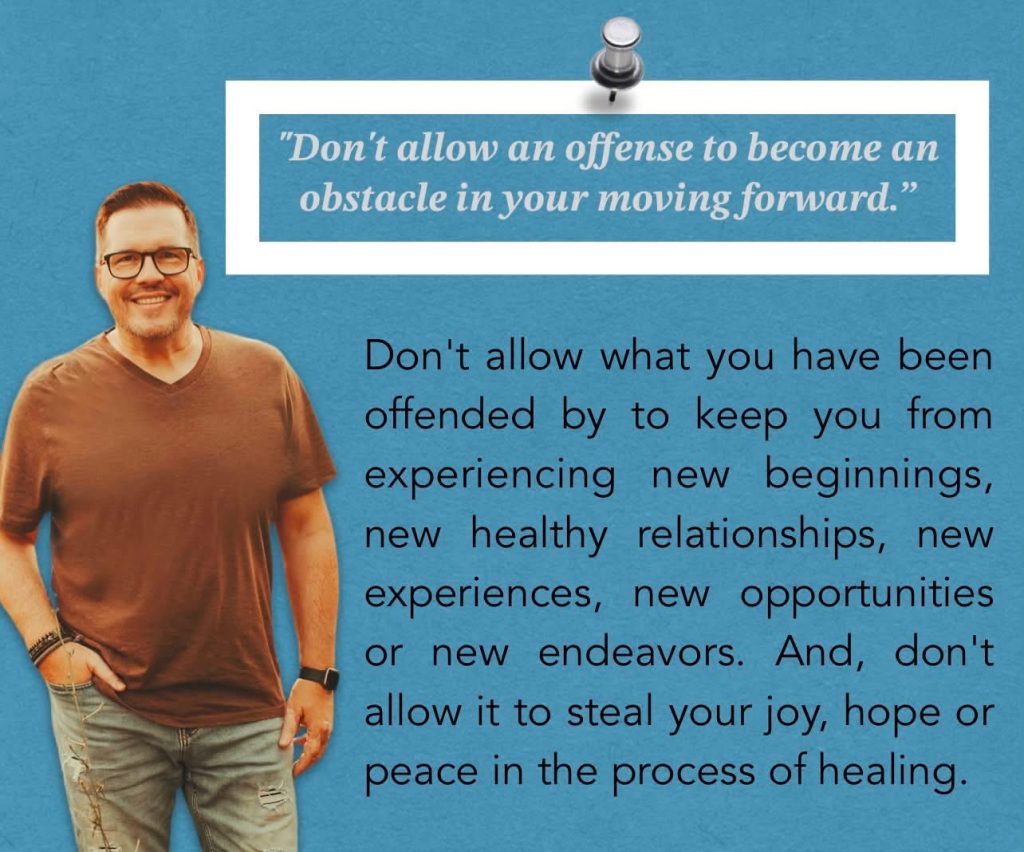
Don’t allow an offense to become an obstacle in your moving forward.
Don’t allow what someone did—or what happened to you—to keep you from experiencing new beginnings, healthy relationships, new experiences, new opportunities, and new endeavors.
You may not be able to control the offense, but you can choose whether you carry it with you.
Forgive. Heal. Learn. Grow. Move forward.
And most importantly, don’t allow yesterday’s offense to steal today’s joy, tomorrow’s hope, or your peace along the way.
“As leaders, parents, and spouses sometimes we have to know what others don’t know, do what others won’t do, and see what others can’t see.” This can at times become a “silent burden”.
I use the word “burden” loosely. However, it starts with the same syllable as “blessing” and I think it’s a good word picture to describe what I am trying to illustrate.
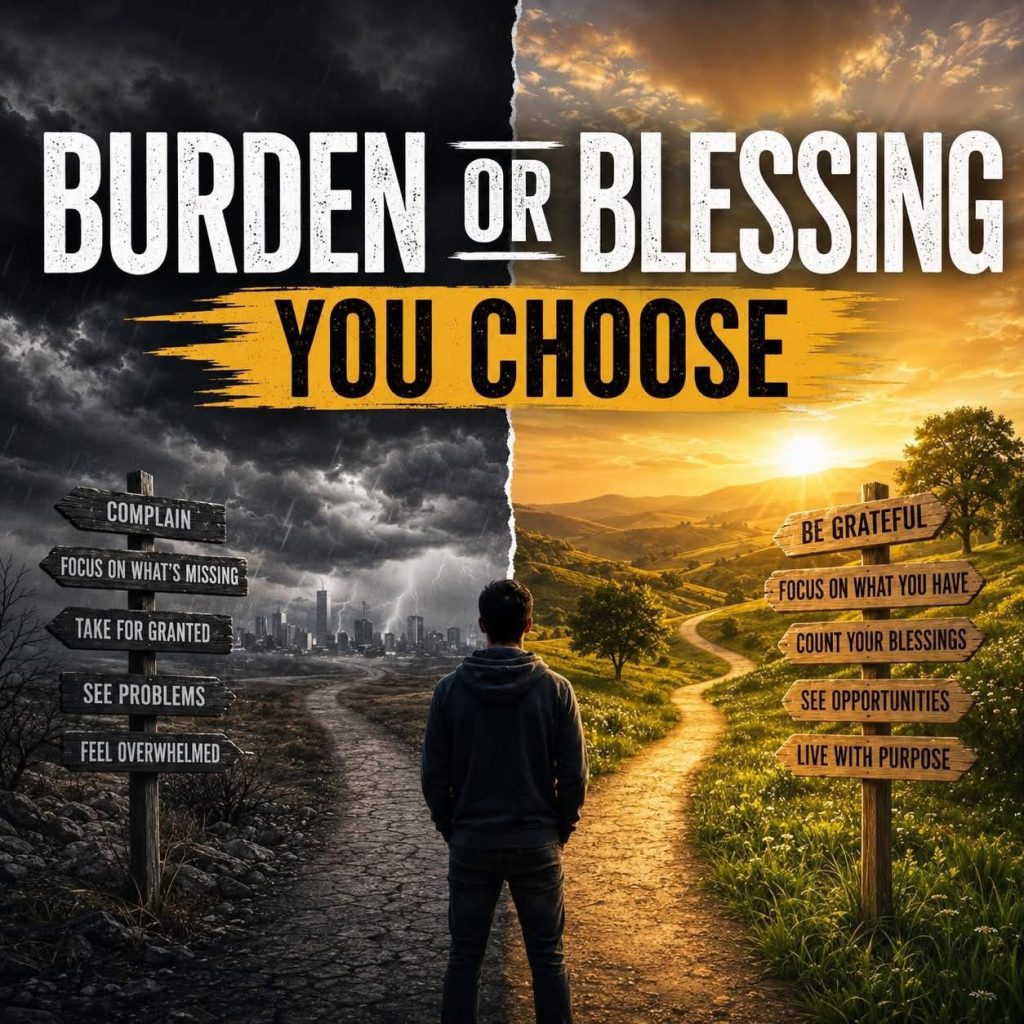
Again, I’m talking about “Blessing or Burden You Choose!”
You have probably heard me say this many times— “don’t allow a blessing to become a burden.” However, for this not to happen, you must be intentional and continually mindful—you also must become more grateful!
You’ve all heard the phrase “The honeymoon wore off.” This phrase describes the excitement of something new beginning to fade, and familiarity taking its place. That’s when gratitude must become a choice.
When this happens you must become intentional about recognizing the value of what you have before familiarity causes you to overlook it.
Gratitude teaches us to see ordinary blessings with fresh eyes and to appreciate again what we may have stopped noticing.
That’s when “gratitude has to become intentional.” When this happens you move from the feeling of gratitude to the practice of gratitude.
And “When the honeymoon wears off, you must become intentional about being grateful.” Being grateful about what you already have.
That’s because it is so easy to take the everyday things for granted! The blessings that surround us every day become commonplace and we forget to be grateful for them.
The following could be substituted for many areas of our lives, but these scenarios below are simple, yet practical areas that help illustrate my point.
Think about this . . .
We complain about traffic (traffic circles) because we have a car.
We complain about laundry because we have clothes.
We complain about doing the dishes because we ate.
We complain about cutting the grass because we have property.
We complain about packing because we get to travel.
We complain about taxes because we earned.
We complain about our job because we have one.
We complain about a full inbox because people need us and we have problems that only we can solve.
We complain about noise because we have a family and friends.
We complain about exercise because our bodies move.
We complain about wrinkles because we have lived.
We complain about gray hair because we have made it this far.
We complain about change because we are growing.
It is all a matter of perspective, and changing your perspective can help produce gratefulness and gratefulness can in turn cause you to see things differently!
What if instead of complaining about traffic (traffic circles)—we were grateful that we have a car.
What if instead of complaining about laundry—we were grateful we have clothes.
What if instead of complaining about doing the dishes—we were grateful because we ate.
What if instead of complaining about cutting the grass—we were grateful because we have property.
What if instead of complaining about packing—we were grateful because we get to travel.
What if instead of complaining about taxes—we were grateful because we have earned.
What if instead of complaining about our job—we were grateful because we have one.
What if instead of complaining about a full inbox—we were grateful because people need us and we have problems to solve.
What if instead of complaining about noise—we were grateful because we have a family and friends.
What if instead of complaining about exercise—we were grateful because our bodies move.
What if instead of complaining about wrinkles—we were grateful because we have lived.
What if instead of complaining about gray hair—we were grateful because we have made it this far.
What if instead of complaining about change—we were grateful because we are growing.
Psalm 103:2—“Bless the LORD, O my soul, and forget not all his benefits.”
David is essentially telling himself, Don’t forget what God has done. Gratitude requires intentional remembrance.
1 Thessalonians 5:18—“In every thing give thanks: for this is the will of God in Christ Jesus concerning you.”
This takes gratitude beyond a feeling and into a practice. “Giving thanks and being grateful” is an intentional action.
Being grateful is a matter of perspective—changing your perspective will help produce gratefulness and gratefulness will in time cause you to see things differently!
Boundaries are not about being hateful or selfish. However, they are beneficial in terms of living a happy, healthy, prosperous and productive life. Time is precious and boundaries help protect the time we have been given. Time is a commodity that we can’t gain back.
“Time doesn’t wait for your permission as it passes by—it seeks your attention to prioritize what matters most.”
Psalms 90:12 says, “Teach us how short our lives are so that we can become wise.”
One of the ways that we can become wise and make the most of our lives is by setting healthy boundaries.
– A boundary is a personal property line.
– Boundaries help define who you are and they make it clear what you prioritize.
– Boundaries help define what you value.
– Boundaries determine who and what you allow into your life.
– Boundaries help define who and what you are responsible for.
– Boundaries are beneficial in every area and aspect of your life.
– Boundaries create safe healthy parameters.
The difference between a swamp and a river is banks—and those banks are boundaries.
The difference between a “mess” and “momentum” is usually healthy and intentional boundaries.
*Most of the time we don’t want to set boundaries because we don’t won’t to appear as being insensitive, mean or selfish.
Nonetheless, in Matthew 14 Jesus shows us that it is not mean, hateful or insensitive to set boundaries. The passage tells us, that after He had fed them, blessed them and taught them—He sent them away.
Boundaries are beneficial and they help prioritize what matters the most.
Boundaries Impact All Areas of Our Life:
1. Physical boundaries help determine who touches you and who is in your personal space and under what circumstances.
2. Mental boundaries give you the freedom to have your our own thoughts and opinions.
3. Emotional boundaries help you deal with your own emotions and disengage from the harmful manipulative emotions of others.
4. Spiritual boundaries help you distinguish God’s will from your own and from others. They will give you a freedom from your Creator and Maker that will establish peace and liberation.
Can you see why boundaries are so important now?
Boundaries deal with every area of our lives.
What You Need to Realize
About Boundaries
1. You can set boundaries and still be a loving and kind person.
2. Boundaries that are legitimate still need to be established with wisdom and in balance.
3. Boundaries aren’t selfish; because they can truly benefit everyone involved.
Most of us don’t need more time, we just need more selective priorities and more intentional boundaries.
Priorities and boundaries are what guard and grow the time that you’ve been given. They help protect you and your time.
“Teach us how short our lives are so that we can become wise.” Psalms 90:12
One of the ways that we gain wisdom and make the most of our lives is by setting healthy boundaries.
Lord, give us the wisdom and the courage to be intentional about creating healthy boundaries that will benefit everyone—amen.
“A father is tender and kind to his children. In the same way, the Lord is tender and kind to those who have respect for him. He knows what we are made of. He remembers that we are dust. The life of human beings is like grass. People grow like the flowers in the field. When the wind blows on them, they are gone. No one can tell that they had ever been there. But the Lord’s love for those who have respect for him lasts for ever and ever. Their children’s children will know that he always does what is right.” Psalm 103:13-17
“Later, Jesus went to Jerusalem for a special Jewish festival. In Jerusalem there is a pool with five covered porches. In Aramaic it is called Bethzatha. This pool is near the Sheep Gate. Many sick people were lying on the porches beside the pool. Some of them were blind, some were crippled, and some were paralyzed. One of the men lying there had been sick for 38 years. Jesus saw him lying there and knew that he had been sick for a very long time. So he asked him, “Do you want to be well?” The sick man answered, “Sir, there is no one to help me get into the water when it starts moving. I try to be the first one into the water. But when I try, someone else always goes in before I can.” Then Jesus said, “Stand up! Pick up your mat and walk.” Immediately the man was well. He picked up his mat and started walking. The day all this happened was a Sabbath day. So some Jews said to the man who had been healed, “Today is the Sabbath. It is against our law for you to carry your mat on the Sabbath day.””